Fiddle or Concertina: Two Different Ways to Carry a Tune
Compare fiddle and concertina in a coastal dance tune, then shape bowing, bellows and phrasing to suit the tune’s lift, pulse and local character.
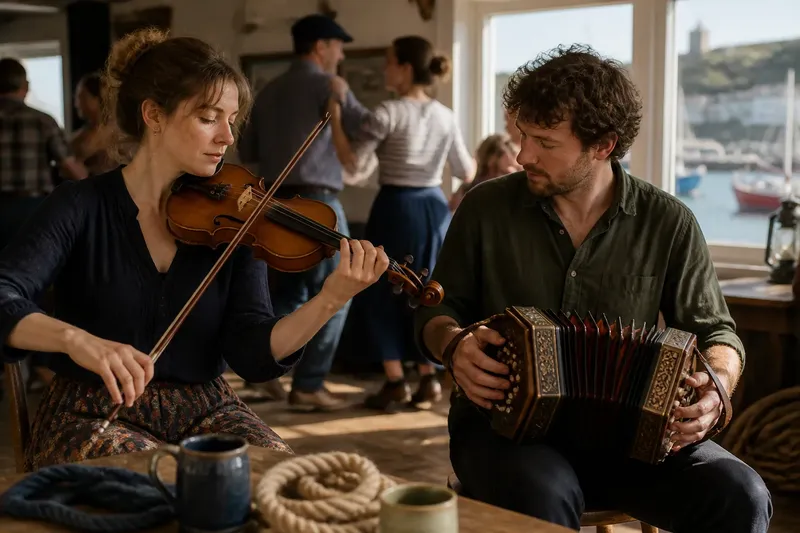
At a harbour dance, a fiddler can let a note ring across a turn while a concertina player can make the same beat seem to breathe in and out. Choosing between fiddle and concertina for a coastal dance tune is not simply a question of which instrument sounds more traditional. Each carries melody differently: the fiddle can sustain and connect notes with the bow, while the concertina’s bellows shape phrases through direction, pressure and breath-like breaks.
To compare them usefully, start with the tune and the way people move to it. Then listen for where its phrases need continuity, where they need a crisp lift, and how the instrument’s physical demands support that character. The aim is not to crown a winner. It is to hear what each instrument makes possible.
Start with the tune’s dance shape
Choose a tune you can hum without the instrument. A reel, jig or local set dance may have a familiar metre, but its identity often rests in smaller details: a pickup into the first phrase, a repeated note that drives the step, or a long turn that gives dancers room to settle. Tap the pulse gently and sing the melody, including any ornaments you already know.
Mark the phrase ends and the notes that seem to carry the tune’s weight. A phrase ending on a held note may welcome a bow that keeps the sound alive. A run of short notes may suit the concertina’s clear attacks, especially if the player can make the bellows change direction without disrupting the pulse. These are starting points, not rules; the same tune can be shaped differently by different players and traditions.
Keep the dance in view. If dancers need a firm, regular beat, avoid treating every expressive detail as an invitation to slow down or stretch the rhythm. A tune’s phrasing can be supple while its underlying pulse remains dependable.
Listen for what the fiddle sustains
The fiddle makes a continuous tone by drawing the bow across a string. That gives the player room to connect notes, lengthen a phrase, and vary the sound while the note is still sounding. On a coastal dance tune, a sustained note can suggest a broad, unbroken sweep, while a lightly lifted bow can bring out a quick turn without making the whole phrase feel heavy.
Listen to how the bow crosses between strings and how the player changes direction. A bow change does not have to sound like a stop: careful timing can keep the melody flowing through it. The player can also separate notes with small changes in bow pressure or articulation, producing a crisp pulse without giving up the capacity to sustain.
That flexibility asks for control. If the bow is pressed too hard, the tone may become rough; if it is drawn too lightly, the sound may lose its centre. For a dance setting, a clear note and a steady pulse usually matter more than a long, showy sustain. Treat held notes as part of the tune’s shape, not as space to fill with extra decoration.
Hear how the concertina breathes
A concertina makes sound as its bellows move, so the player’s phrasing is tied to direction and pressure. Each key action can produce a direct, distinct attack, and a change of bellows direction can create a natural point of articulation. This can give a tune a lively, speech-like quality: notes seem to arrive in small, shaped groups rather than flowing from one long bow stroke.
That quality can suit a dance melody with repeated notes, clipped turns or a buoyant rhythmic figure. The bellows can add emphasis to a phrase, soften a note, or create a small break between musical thoughts. But the player has to plan the bellows so a direction change does not land awkwardly on a note that ought to remain smooth.
Concertinas differ in layout and response, and a player’s approach also reflects their instrument and local practice. Some systems make particular notes available on different bellows directions; others are arranged differently. Do not assume that a fingering or bellows pattern transfers from one instrument to another. Follow the maker’s guidance for the instrument and the conventions of the playing tradition you are learning.
Shape one phrase on each instrument
Take a short phrase and sing it once at a comfortable dance pace. Identify its strongest note, its pickup, and the point where it turns back towards the next phrase. Then try to preserve those features on each instrument rather than copying the same mechanics.
- On fiddle: If the phrase has a held ending, connect the preceding notes with a suitable bow and keep the ending tone steady; if the ending needs a sharper lift, separate the approach notes with clear strokes instead.
- On concertina: If the phrase’s important notes fall comfortably within the planned bellows direction, keep pressure even through the run; if a direction change interrupts a note that should flow, revise the bellows plan or simplify the phrase.
- For the pulse: If the melody remains easy to step to while you add an ornament, keep it; if the ornament blurs the beat, remove it and play the notes plainly.
- For phrase shape: If the pickup leads clearly into the main note, preserve its lightness; if it sounds as heavy as the main note, reduce its emphasis or alter the bowing or bellows pressure.
- For the group: If another melody player has room to answer, leave that space; if both lines crowd the same moment, simplify one part or alternate who carries the tune.
- For the room: If the tune’s outline is clear in the gathering, keep the current force and note density; if it is difficult to follow, make the melody plainer and adjust your playing rather than adding extra notes.
Say you are working on an invented harbour reel whose first phrase rises through short repeated notes and ends on a longer tone. You sing the phrase, mark the repeated notes as the rhythmic drive, and decide the last tone should remain smooth. On fiddle, you use separate, even bow strokes for the repeated notes, then draw the bow through the ending. On concertina, you plan the bellows so the repeated notes have clean attacks and the final tone does not meet an awkward direction change. The resulting contrast is audible: the fiddle connects the ending through the bow, while the concertina shapes it through sustained bellows pressure. If the concertina’s direction change interrupts that ending, the trade-off is clear: revise the bellows plan or choose the fiddle for this phrasing.
Fit the phrasing to the people dancing
In a shared set, listen to the other musicians before making the melody more elaborate. A guitar or small stringed instrument may provide a steady harmonic pulse; another melody player may be carrying the tune in a contrasting register. Fiddle and concertina can both lead, but they leave different kinds of space for that company.
The fiddle can stretch a phrase’s tone while the accompaniment keeps the beat moving underneath. The concertina can make rhythmic edges especially clear, which may help a tune feel nimble and direct. Neither effect is automatically better for dancers. Notice whether the pulse remains easy to follow and whether the phrase gives the next player room to join or answer.
In a small gathering, volume and balance matter as much as articulation. A strong bow sound can dominate a close room; a concertina’s clear attacks can also stand out sharply. Adjust the force and density of playing rather than adding more notes. In an outdoor setting, wind and open space can change what carries, so keep the melody’s outline plain enough to remain recognisable.
Which instrument serves this tune best?
Start with the phrase you are actually playing, rather than choosing by a general claim about which instrument is easier or more traditional. Listen for the sound the tune needs, then account for the player’s control, the instrument’s layout and the space shared with dancers and other musicians.
Which instrument is easier for a beginner to phrase?
Neither offers an effortless route to expressive playing. A concertina gives notes a direct attack but asks the player to coordinate keys and bellows; a fiddle allows long connected tones but requires bow control and clean string changes.
Can a concertina sustain a note like a fiddle?
A concertina can hold a tone while the bellows move, but its sound depends on available air and controlled pressure. Its sustain is shaped by bellows management, rather than by a bow continuing across the string.
Which instrument suits repeated notes in a dance tune?
Both can make repeated notes lively and clear. The fiddle can articulate them with separate bow strokes or changes in bow direction, while the concertina can give each note a distinct attack shaped by its keys and bellows.
Should both instruments play the same melody together?
They can, if the players agree on the tune’s pace and leave room for each instrument’s phrasing. A useful arrangement may let one carry the melody plainly while the other supports it with a lighter response or a simpler version of the line.
Choose by listening to the phrase
When choosing between fiddle and concertina, hum the tune, mark its phrase shape, and notice whether its character depends more on sustained connection or bellows-shaped articulation. Then play a short passage on each instrument, keeping the dance pulse steady and the ornaments modest. Listen for which version makes the tune’s strongest details easiest to hear.
There is little value in forcing a tidy contest between the two. A fiddler can articulate sharply, and a concertina player can shape a flowing line; skilled playing can cross the apparent boundary. What is not worth the effort is copying another player’s phrasing note for note before understanding what the phrase is doing. In a coastal dance tune, the better choice is the instrument that lets this melody speak clearly, while leaving the dancers and the other musicians room to answer.