Why the Sea Is Rarely Just Background Sound
Learn how to hear the sea as musical material: follow water, wind and distance to tell an active sonic setting from atmosphere alone.
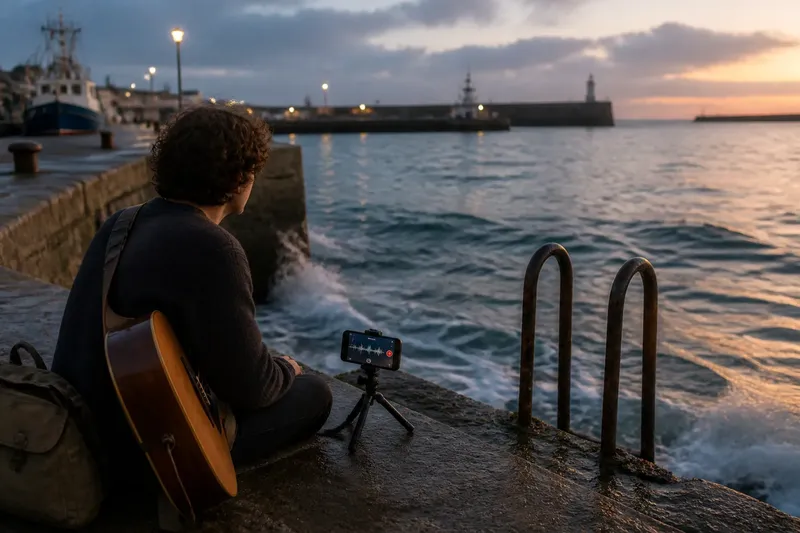
A songwriter sits beside a harbour wall with a phone recording the slap of water against a ladder. In the first take, the sound sits behind a guitar as pleasant coastal colour. In the next, the singer pauses whenever a wave strikes, and the guitar answers with a short, uneven phrase. The sea has stopped being scenery: its timing now changes the music. That is the difference between sonic setting and mere atmosphere.
To hear that difference, listen for what the environmental sound makes the music do. Water can set a pulse, interrupt a line or blur a pitch. Wind can alter the apparent force of a voice. Distance can make one sound feel near and another unreachable. If the arrangement would behave in exactly the same way without these details, the sea is probably functioning as background.
Listen for a relationship, not a coastal sound effect
A gull call, surf wash or foghorn does not become musical material simply because it appears in a track. The useful question is whether the sound has a relationship with the other parts. Does the singer leave space for it? Does a repeated wave pattern shape the rhythm? Does the harmony become less settled as the sound recedes?
Those relationships need not be tidy or literal. A composer might echo the rising and falling shape of a swell in a melody without using a field recording at all. A guitarist might choose open, ringing notes that suggest a long acoustic tail, then cut them short when the lyric turns towards a close, intimate image. In either case, a listener can hear the environment influencing decisions rather than decorating them.
Listen once for the environmental layer, then again for the music around it. Notice entrances, pauses, changes in loudness and sounds that overlap. If the water is prominent but nothing reacts to it, it may be an atmospheric bed. If its presence changes phrasing, texture or expectation, it is doing structural work.
Imagine one harbour recording becoming part of a song
Say a songwriter has recorded water tapping a loose wooden fender, with traffic rumble from the road beyond the quay. The first version puts the recording beneath a steady strummed chord. The taps arrive irregularly, but the guitar keeps an even pattern and the vocal runs across the sound without a pause. The result suggests a place, yet the recording does not affect the song.
For a second version, the songwriter keeps the same field recording but changes the arrangement. The guitar plays a short phrase, then leaves a gap where a cluster of fender knocks can be heard. The singer begins the next line after the knocks, not on a fixed beat. In the final verse, the traffic rumble is allowed to swell while the guitar becomes quieter. The expected audible result is a song with uneven breathing: the harbour sounds seem to interrupt and answer, while the distant road makes the ending feel less enclosed.
Nothing in this imagined change makes the recording inherently more authentic. The fender is not a certificate of local knowledge, and the traffic does not explain the harbour on its own. What changes is the listener’s role: the ear starts anticipating the next knock and noticing how the performer responds. The environment has become part of the song’s timing and perspective.
Use water and wind for different kinds of motion
Water often suggests repeated motion with variation. Small waves can produce a loose pulse, while a single wash can mask a phrase and then release it. A song need not imitate either sound directly. It can borrow the sense of recurrence: a bass note returns, but the vocal changes its ending each time, as if the musical surface were never quite still.
Wind is less predictable as a musical image. It can obscure detail, push a sound towards distortion or make a quiet voice seem exposed. A close-miked vocal beside a broad, noisy wind recording may feel fragile; a clipped drum pattern against the same wash may feel resistant. The effect depends on contrast. If every part is equally blurred, the listener may have little to grasp.
These are not fixed meanings. Surf does not always signify calm, and wind does not automatically signal danger or freedom. The arrangement supplies the context. A gentle, repetitive melody can make rough water sound familiar; a tense harmony can turn an otherwise soft wash into something unsettled. Hear the musical choices before assigning a mood to the landscape.
Let distance shape what the listener can know
Distance is more than a volume change. A sound that seems far away may lose detail and blend with other noises, while a nearby sound exposes texture: a rope creak, a drain gurgle, a breath before a phrase. Moving between these perspectives can make a song feel as if it is looking out from a specific place rather than presenting a general coastal view.
Try tracing one sound through the track. Does it remain near the listener while the voice recedes? Does the singer sound close at first, then become hard to distinguish from the wind? Does a horn appear only as a faint pitch at the edge of hearing? Such choices can carry meaning without an explanatory lyric. The listener senses separation, attention or uncertainty through the changing relationship between foreground and distance.
Distance can also be created without field recording. A dry, close vocal against long, soft instrumental tones can suggest a nearby person in a spacious place. Conversely, a reverberant voice over a sharply defined acoustic guitar may feel removed from the listener, even if no literal shoreline sound appears. The important cue is contrast between near and far, not a stock ocean effect.
What should you listen for in a sea-shaped song?
How can I tell setting from atmosphere?
Ask whether the water, wind or distant noise changes the timing, phrasing, texture or focus of the music. If removing it would leave every musical event untouched, it is likely serving mainly as atmosphere.
Does a song need real wave recordings?
No. Repetition, interruption, open space and changing pitch can evoke water through instruments and arrangement alone. A field recording is one option, not proof that the music is more closely tied to a coast.
Why do some environmental sounds disappear under the song?
A sound can be deliberately masked, or it may simply occupy the same sonic space as an instrument or voice. Listen for what remains audible at transitions and pauses, where a mix often gives quieter details room to register.
Can a coastal sound suggest a place without naming it?
It can suggest a kind of acoustic space, but a gull or foghorn rarely identifies a particular harbour by itself. Specificity comes from how the sound is combined with performance, language and other local details.
Keep the recording’s limits audible
A field recording carries the conditions of its capture: microphone direction, handling noise, nearby machinery and the recorder’s position. These details may be useful. A little rumble can place the listener near a working quay; a sudden change in wind noise can make a vocal seem momentarily uncovered. But accidental distortion does not automatically communicate a coastal scene. It may simply distract from the musical relationship the songwriter wants to establish.
Before adding a recording, decide what role it has. Is it a pulse, an interruption, a distant presence or a shift in perspective? Then make room for that role in the arrangement. Lowering an instrument during a key sound or leaving a pause may clarify the idea more effectively than adding several layers of surf, gulls and bells.
Not worth the effort: piling on familiar seaside sounds to make a track feel coastal. A crowded collection of effects can turn a specific harbour into a generic postcard, especially if no part of the performance responds to what is heard.
Carry the listening question to the next song
When a sea recording appears, follow its effect rather than naming its source straight away. Notice what it interrupts, what it echoes and what it makes difficult to hear. Then consider the same question when no water is present: where does the music place the listener, and how does that distance shape the performance?
That is a useful way to hear the sea as musical material. The sound need not dominate or explain the song. It only needs to alter what happens between the notes, so the shoreline is not merely heard behind the music but felt in the way the music moves.